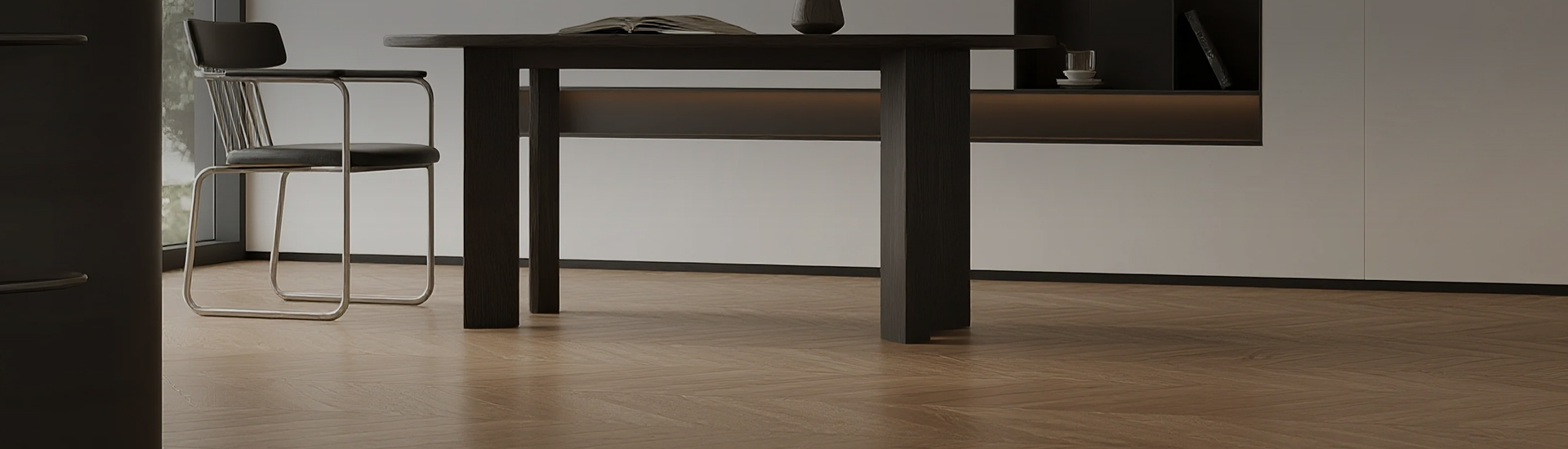
Oak engineered wood flooring combines a genuine hardwood veneer surface with a dimensionally stable multi-layer core, delivering the visual warmth of solid wood alongside performance advantages that solid planks simply cannot match. The core — typically constructed from cross-grain plywood or high-density fiberboard (HDF) — counteracts the natural tendency of wood to expand and contract with changes in ambient humidity and temperature. This structural intelligence is what makes engineered oak a preferred specification for architects, interior designers, builders, and homeowners across residential and commercial sectors worldwide.
As innovative trends in oak engineered wood flooring continue to evolve, demand for products that balance aesthetic depth with technical reliability has accelerated significantly. Sinomaple's Red Oak Series sits at the center of this shift.
Red oak (Quercus rubra) is one of North America's most widely used hardwood species, prized for its open, pronounced grain, warm reddish-amber tones, and a Janka hardness rating that makes it well-suited to both residential and light commercial traffic. Its grain accepts stains and finishes uniformly, giving manufacturers — and end clients — considerable flexibility in achieving a wide range of visual results. Sinomaple's Red Oak Series leverages these natural properties by pairing select-grade or natural-grade veneer surfaces with precision-engineered cores to produce flooring that holds up under daily use while retaining its character over time.
Comparisons between solid wood vs. engineered wood flooring consistently highlight the advantage engineered oak offers in climates with seasonal humidity swings — a critical factor for markets across North America, Europe, the Middle East, and East Asia where Sinomaple's products are actively exported.
The performance of any engineered floor begins with how it is built. Sinomaple's Red Oak engineered planks use either a multilayer plywood core or a 3-layer construction, both assembled using a tongue-and-groove (T&G) profile that ensures tight, gapless fitting during installation. Each layer is oriented perpendicular to the adjacent one — a cross-grain arrangement that minimizes the risk of cupping, bowing, or gapping under environmental stress.
Total board thickness across the Red Oak Series is typically 15 mm, which supports all three primary installation methods: floating, glue-down, and nail/staple-down. The veneer layer — sourced from genuine red oak — is thick enough to accommodate light sanding and refinishing, extending the product's service life well beyond what thinner veneers permit.
Surface treatments within this series include brushed and mat finish options. Brushed surfaces introduce a subtle tactile texture that accentuates the natural grain while adding slip resistance — a practical consideration for living areas and commercial environments alike. The mat finish reduces light reflection to create an understated, contemporary visual that is particularly well-suited to modern and transitional interiors.
For a detailed comparison of how engineered wood floorboards differ structurally from solid wood alternatives, Sinomaple's technical resources provide an in-depth breakdown of construction variables.
The Red Oak Series currently includes eleven SKUs — from IN 25-0401 through IN 25-0411 — each available in multiple layout formats to accommodate diverse design requirements. Confirmed specifications from the product range include:
Veneer species: Red Oak (Quercus rubra), select or better / natural or better grade.
Core construction: Multilayer cross-grain plywood or 3-layer engineered T&G.
Total thickness: 15 mm across all layout formats.
Surface treatment: Brushed, with mat lacquer finish.
Finish sheen: Matte — low-glare, contemporary appearance.
Layout formats available within IN 25-0411 and related SKUs:
Straight Plank — 600–1900 mm length × 190 mm width × 15 mm thickness, natural grade, brushed surface. The longest and most versatile format, suited to open-plan living spaces and wide-corridor commercial environments.
Herringbone — 600 mm × 125 mm × 15 mm, select grade, brushed. A classic diagonal pattern that creates a sense of movement and visual interest in hallways, entryways, and boutique retail spaces.
Chevron — 475 mm × 125 mm × 15 mm, select grade, brushed. Distinguished from herringbone by its angled cut ends, which create a continuous V-pattern with no interruption at the joint.
Tea Leaf — 350 mm × 190 mm × 15 mm, select grade, brushed. A distinctive parquet variant offering a unique geometric rhythm suited to feature areas and accent flooring.
Versailles — 800 mm × 800 mm × 15 mm, select grade, brushed. A grand classical panel pattern historically associated with luxury interiors; ideal for hotel lobbies and high-end residential reception areas.
Blois — 800 mm × 800 mm × 15 mm, select grade, brushed. A French-inspired parquet panel that pairs naturally with period-style and contemporary luxury interiors.
This breadth of format options reflects Sinomaple's capacity for project-level customization — a key differentiator for procurement teams working across multiple interior schemes. Browse the full Red Oak Series product range to compare individual SKUs.
Grade classification within the Red Oak Series follows established hardwood flooring conventions. Select or better grade minimizes visible knots, color variation, and sapwood, producing a clean, consistent surface well-suited to formal or premium interiors. Natural or better grade retains more of the wood's inherent character — including mineral streaks, slight grain variation, and occasional small knots — creating a more organic, lived-in aesthetic that is increasingly popular in residential and hospitality design. Both grades are available brushed and finished with the same durable mat lacquer.
Factory-applied finishes on engineered hardwood have evolved significantly. Sinomaple's Red Oak Series uses a multi-coat UV-cured lacquer system that delivers hardness, chemical resistance, and consistent sheen without the variability associated with site-applied finishes. UV curing cross-links the finish at a molecular level within seconds of application, producing a surface layer that is harder and more abrasion-resistant than conventional air-dried lacquers.
The brushed surface treatment preceding the finish application removes softer earlywood fibers, leaving the harder latewood grain raised and tactile. This not only enhances visual depth and texture but also helps conceal minor scuffs and surface wear that accumulate through daily use — a practical advantage in both residential and commercial settings.
Industry discussions around dark oak engineered flooring market trends have increasingly highlighted fire-resistance treatment as an emerging specification requirement for commercial and hospitality projects. Sinomaple's manufacturing capabilities address this demand within its broader engineered flooring range.
One of the principal technical advantages of 15 mm engineered oak over solid hardwood is its compatibility with a wider range of subfloor conditions and installation methods.
Floating installation places planks on an underlay without mechanical fastening, allowing the floor to move as a unit over the subfloor. This method is fast, reversible, and requires no adhesive. It is well-suited to renovation projects where speed matters and where the subfloor surface is uneven or mixed.
Glue-down installation bonds planks directly to the subfloor using an elastomeric or hard-set adhesive. This method is preferred over concrete slabs and in environments with underfloor radiant heating, as it eliminates hollow spots and transmits heat more efficiently from the slab to the floor surface.
Nail or staple-down installation attaches planks mechanically to a timber subfloor. This traditional method produces a solid underfoot feel and is the standard approach in new timber-frame construction.
Subfloor moisture content is a critical variable in all three methods. Before installation, the subfloor should be tested and confirmed within acceptable ranges — typically below 3% by weight for concrete and within 2–4% of the flooring's own moisture content for timber subfloors. A vapor retarder or moisture barrier should be used wherever there is any risk of upward vapor transmission, particularly over concrete slabs.
Acclimation of the flooring itself — leaving planks in the installation space for 48 to 72 hours before laying — allows the product to equilibrate with the ambient conditions of the room, minimizing post-installation movement.
Sinomaple's Red Oak engineered flooring is specified across a wide range of end-use environments. In residential construction and renovation, it suits living rooms, bedrooms, dining areas, home offices, and upper-level rooms — including where moisture control over below-grade concrete is a consideration when the appropriate moisture mitigation is in place.
In the hospitality sector — hotels, serviced apartments, and boutique accommodations — the combination of durable factory finishes, brushed texture, and the availability of parquet formats such as Herringbone, Versailles, and Blois makes this range particularly well-suited to premium guest room and public area specifications.
In retail and commercial interiors, the dimensional stability and surface hardness of engineered oak make it a practical choice for boutique stores, showrooms, and office environments where appearance and performance must coexist under sustained foot traffic.
For project teams working on complete interior fit-outs, Sinomaple's product portfolio extends beyond flooring — the company's kitchen cabinet, bathroom vanity, and interior doors ranges provide coordinated material selections under a single supply relationship.
Engineered construction is inherently more resource-efficient than solid hardwood production. Because only the surface veneer layer requires slow-grown, premium-quality hardwood, engineered flooring yields significantly more usable floor area per cubic meter of harvested timber. The structural core layers are typically produced from plantation-grown softwood or reconstituted wood materials, further reducing pressure on primary forest resources.
Sinomaple holds certifications that validate both environmental performance and product safety. These include FSC-COC and CFCC-PEFC chain-of-custody certification, confirming responsible timber sourcing throughout the supply chain. The company's products meet CARB Phase 2 emissions standards — the benchmark for formaldehyde emissions in composite wood products applicable to the North American market — and hold SCS-EPA verification. Additional certifications include ISO 9001 (quality management), ISO 14001 (environmental management), ISO 45001 (occupational health and safety), FloorScore (indoor air quality), CE marking for the European market, and LEED-recognized status for both oak and walnut wood products.
Sinomaple operates a proprietary laboratory at its Suzhou manufacturing facility equipped with a 1-cubic-meter VOC environmental chamber, gas sampler, and gas chromatograph (GC) for TVOC testing — enabling in-house verification of emissions performance before products leave the factory. Learn more about the company's environmental commitments on the sustainability page.
The global market context for sustainable flooring is also addressed in Sinomaple's editorial coverage. The article on hybrid engineered wood flooring examines how newer engineered formats are reshaping procurement decisions across the industry, while coverage of light wood engineered flooring trends documents the design directions driving current specification activity.
Properly maintained, engineered oak flooring delivers decades of service without significant degradation in appearance. Routine care involves dry sweeping with a soft-bristle broom or microfiber mop to remove dust and fine grit — the primary source of surface micro-scratching over time. Where damp mopping is necessary, use a well-wrung, slightly damp cloth or mop rather than saturating the surface.
Avoid steam mops entirely on engineered wood. While the engineered core is more resistant to moisture-driven movement than solid hardwood, repeated steam application can penetrate through the finish and cause veneer delamination or joint swelling over time.
Protective felt pads should be fitted under all furniture legs. In high-traffic pathways, entrance mats help prevent grit from being tracked across the floor surface. Maintain indoor relative humidity between approximately 35% and 65% to minimize seasonal movement. Direct prolonged UV exposure can cause color change in natural timber species; window treatments or UV-filtering glass help slow this process.
Founded in 2002, Sinomaple Floors Inc. operates from a 200,000 square meter modern manufacturing facility in Suzhou, Jiangsu, China. The company maintains an annual production capacity of 5,000,000 square meters of flooring alongside 100,000 cabinet sets and 100,000 interior door sets, supported by a domestic retail network of more than 500 terminals across 30 provinces and a direct export program reaching over 20 countries including the United States, Canada, France, Italy, Australia, South Korea, Japan, and Saudi Arabia.
The company's development history spans more than two decades of recognized industry leadership — including being named a Preferred Supplier of China Real Estate Top 500 and receiving Top 10 Flooring and Cabinet Brand recognition in multiple years. Its Industry 4.0-integrated manufacturing and service model supports flexible minimum order quantities, custom specification development, and personalized project support for international buyers.
For procurement teams and design professionals evaluating the full flooring range, Sinomaple's collection extends across the Red Oak Series, European Oak Series, Walnut Series, Ash Series, and Teak Series — each addressing distinct aesthetic and performance requirements.


